Construction workers and silica dust finally got their reckoning. Kitchens are next, and most owners are not ready for it.
The construction industry spent decades watching workers develop silicosis from preventable dust exposure before enforcement caught up with reality. The pattern in commercial kitchens is following the same arc. Slow accumulation. Symptoms that look like ordinary illness. Damage that shows up years after the exposure. By the time a chef is diagnosed with occupational asthma, they have already worked 2,000 shifts breathing in the thing that caused it.
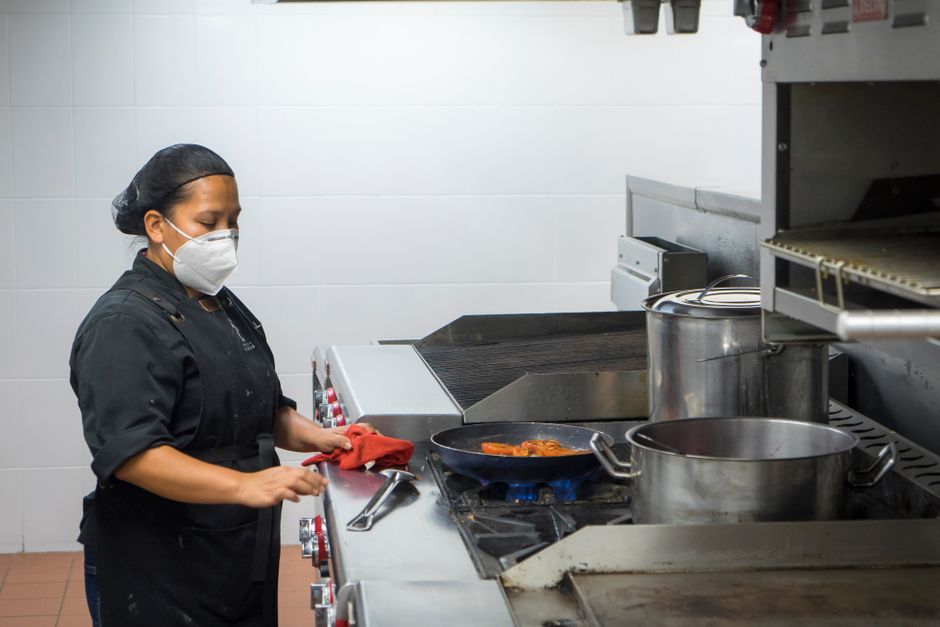
The hazards in a commercial kitchen are not exotic. They are flour, steam, acrolein from burning fats, nitrogen dioxide from gas hobs, and chlorine-based cleaning products used in enclosed spaces with the extractor fan on minimum because the noise drives everyone mad. Every one of those is a documented respiratory sensitiser or irritant. Every one of them is present in most kitchens every single day.
What Is Actually in the Air
Flour dust is the one that surprises people most. It is classified as a respiratory sensitiser, meaning it does not just irritate the airways, it can permanently reprogram the immune system to treat wheat protein as a threat. Once that sensitisation happens, even tiny subsequent exposures trigger an asthmatic response. A baker who develops occupational asthma from flour dust cannot safely work around flour again. That is a career-ending diagnosis, not a manageable condition.
The occupational exposure limit for flour dust in Ireland, set under the Safety, Health and Welfare at Work (Chemical Agents) Regulations, is 1 mg/m³ as an eight-hour time-weighted average. In a busy bakery section with poor ventilation, levels routinely exceed 10 mg/m³. Most kitchens have never measured it.
Cooking fumes are the second hazard that gets dismissed. Heating oil to high temperatures releases acrolein, polycyclic aromatic hydrocarbons, and particulate matter in the respirable size range, meaning particles that bypass the upper respiratory system and deposit directly in the lungs. Wok cooking, deep frying, and chargrilling are the worst offenders. The evidence connecting high-heat cooking fumes to lung cancer in professional cooks has been building for thirty years.
Cleaning products are the third category, and the one most likely to cause an acute incident rather than a slow-burn disease. Mixing chlorine-based sanitisers with acidic descalers produces chlorine gas. It happens in kitchens. Staff do it without knowing. The result ranges from throat irritation to pulmonary oedema, depending on concentration and duration of exposure.
Why Kitchens Get a Pass
Food safety inspection in Ireland focuses on temperature control, allergen management, pest control, and hygiene. An Environmental Health Officer inspection will check your HACCP documentation and your fridge temperatures. The inspector is not primarily looking at whether your larder section has adequate fresh air exchange or whether your cleaning staff are mixing chemicals without respiratory protection.
That gap exists because food safety regulation and occupational health regulation run on separate tracks. The Food Safety Authority of Ireland owns the kitchen inspection regime. The Health and Safety Authority owns the occupational exposure limits and chemical agents rules. Neither is wrong in what they cover. The problem is that most food businesses treat the EHO inspection as the totality of their compliance obligation and never think about the HSA dimension at all.
The Safety, Health and Welfare at Work Act 2005 applies to every employer in Ireland, including every restaurant, hotel kitchen, hospital canteen, and food production facility. The obligation to assess and control exposure to hazardous substances does not disappear because you are making soup rather than cutting granite.
What the Law Actually Requires
Under the Chemical Agents Regulations, any employer who uses or produces a hazardous substance at work must carry out a risk assessment. Flour dust is a hazardous substance. Cooking fumes are a hazardous substance. Bleach-based sanitisers are hazardous substances. The assessment needs to consider who is exposed, for how long, and at what likely concentration.
Where exposure cannot be eliminated, controls must be applied in a defined hierarchy. Substitution first. Then engineering controls. Then administrative controls. Then, and only then, personal protective equipment. The extractor fan above the fryer is an engineering control. It only works if it is sized correctly for the volume of fumes being generated, maintained regularly, and actually switched on. A 20-year-old canopy hood with grease-blocked filters running at 40% capacity is a checkbox that delivers nothing.
Respiratory protective equipment, an FFP3 mask or a half-face respirator with appropriate filters, is the last line of defence. In most kitchens it is the only line of defence, and it is typically absent even then.
The Practical Fixes
Ventilation design is where the money goes, and it is worth spending it correctly from the start. A commercial kitchen ventilation system should achieve a minimum of 60 air changes per hour in the cooking zone. The canopy should extend 300mm beyond the cooking equipment on all open sides. Extract and supply air must be balanced or the canopy creates negative pressure and draws fumes back into the breathing zone.
Get the filters serviced. A quarterly clean is the minimum for a busy kitchen. Monthly for high-volume fryers and chargrills.
Separate your chemical storage and your chemical use. Write a one-page compatibility chart and post it inside the cleaning cupboard. If a staff member cannot read English fluently, that chart needs to be in their language or use pictograms. Chlorine and acid in the same hand at the same time is not a theoretical risk.
When buying new cleaning products, check the Safety Data Sheet before you sign the order. Section 8 tells you what respiratory protection is required. If it says half-face respirator and you are handing the product to a kitchen porter in a small prep room, you need that respirator on site before the product arrives.
Train the team. Not a laminated poster. An actual twenty-minute conversation about what is in the air, what it does to lungs over time, and what the controls are. Occupational asthma is preventable. Once it develops, it is not reversible.
The Turn
The construction industry learned its respiratory lessons through prosecutions, compensation claims, and a generation of workers with damaged lungs. Food businesses are not exempt from that trajectory. The HSA has enforcement powers in every kitchen in Ireland. The question is whether the industry waits to be made to act or gets ahead of it.
Your staff are breathing in these hazards for eight hours a day, five days a week, for years. That deserves more than a working extractor fan and good intentions.